

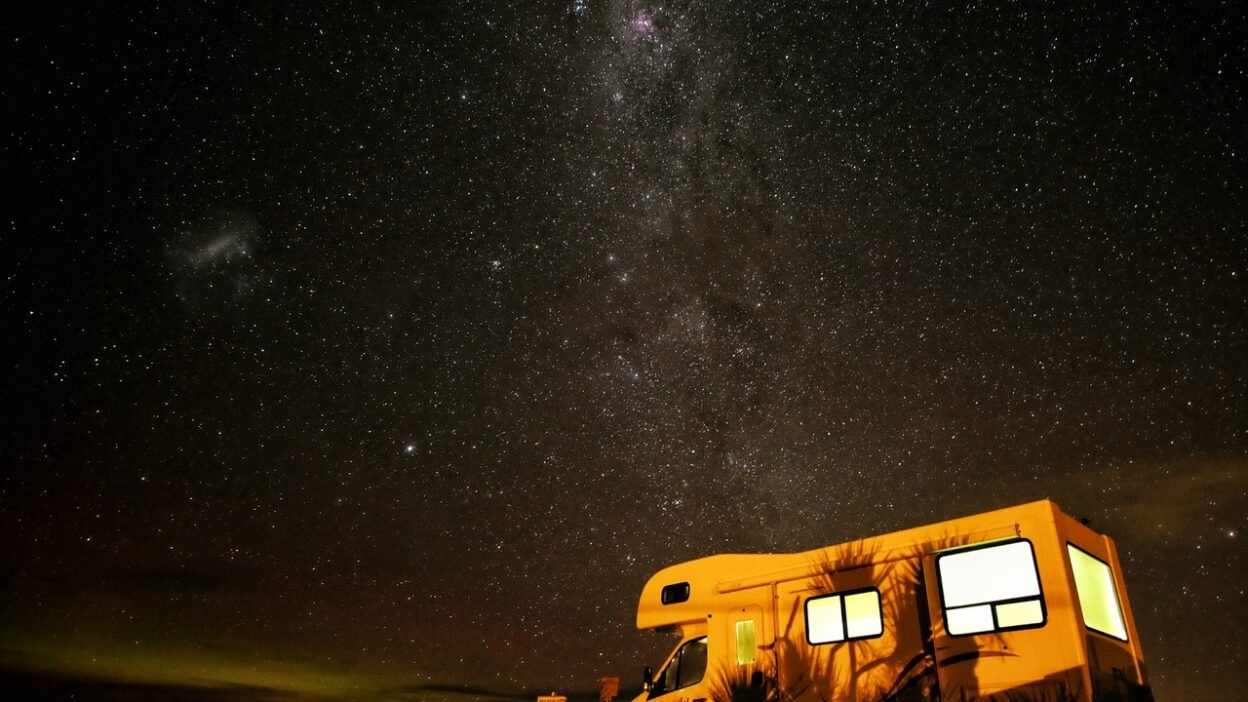
Ready for your first stellar adventure? You don’t need to invest a single euro. Tonight, from your motorhome, you can start deciphering the mysteries of the sky using only your eyes and these game-changing tricks.
Forget expensive and complicated equipment. The best telescope you have is already with you: your own eyes, if you know how to use them correctly.
The most important trick: The golden 20-minute rule
Here’s the best-kept secret of amateur astronomy: your eyes need time to become super eyes.
When you step out of your motorhome and look up, you only see a few scattered stars. But wait 20 minutes without looking at any white light and prepare for the show of your life.
What happens in those magical 20 minutes?
- Minutes 1-5: You see the brightest stars
- Minutes 5-10: Fainter stars appear
- Minutes 10-15: The Milky Way begins to emerge
- Minutes 15-20: BOOM! The sky explodes into thousands of points of light
Golden rule: One single glance at a white light (phone, flashlight, motorhome interior) and back to square one. 20 minutes lost in one second!
Pro tip: Close one eye when you need to look at a light. This way you maintain night vision in the eye you’ve kept closed.
Your magic flashlight: The power of red light
Red light is your best ally for maintaining night vision. Unlike white light, red light doesn’t reset your dark adaptation.
Turn your phone into the perfect tool:
Method 1: The homemade filter (5 minutes)
- Get a piece of red cellophane or cellophane paper
- Stick it over your phone’s flashlight with adhesive tape
- Done! You now have your astronomical flashlight
Method 2: Specialized apps
- Download a “red flashlight” app
- Adjust brightness to minimum
- Perfect for reading star charts
Method 3: Screen settings
- Activate the red filter in your screen settings
- Turn brightness down to maximum
- Use it to check astronomy apps
The basic sky map: Your stellar GPS
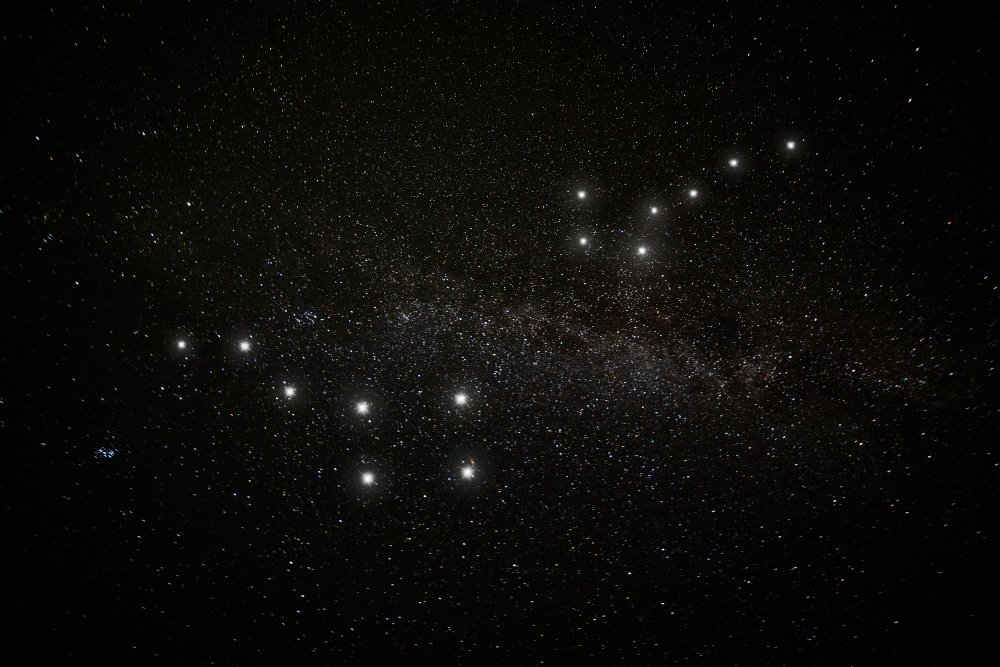
If you only learn one constellation in your life, make it the Big Dipper. It’s your cosmic compass, visible all year from Spain and the key to orienting yourself anywhere.
Step 1: Find the Big Dipper (The Plough)
- Look for it towards the north
- Shaped like a ladle or shopping cart
- Seven bright stars forming the most recognizable pattern in the sky
- In summer: High in the sky at dusk
- In winter: Lower, but always visible
Step 2: Locate the Pole Star
The foolproof trick:
- Identify the two stars on the “edge” of the ladle (the ones furthest from the “handle”)
- Draw an imaginary line between these two stars
- Extend that line about 5 times its distance upward
- There it is! A solitary, bright star: the Pole Star
Why is it so important?
- The Pole Star marks geographic North (with less than 1° precision)
- It doesn’t move while all other stars rotate around it
- It’s your reference point for orienting yourself anywhere in the northern hemisphere
Traveler’s trick: Point your arm towards the Pole Star. You’re pointing at true North. Now you know where South, East, and West are. Your stellar GPS works better than your car’s!
Star or planet? The foolproof twinkling trick
One of the most frequent questions: “Is that bright light a star or a planet?”
The twinkling rule that never fails:
🌟 STARS = TWINKLE
- Stars twinkle and change intensity
- Their light comes from enormous distances
- Earth’s atmosphere makes them “dance”
🪐 PLANETS = STEADY LIGHT
- Planets shine with constant and steady light
- They are much closer than stars
- Their light is more stable when passing through our atmosphere
The easiest planets to identify:
- Venus: The brightest, visible at dawn or dusk
- Jupiter: Very bright, white-yellowish color
- Mars: Characteristic reddish color
- Saturn: Yellowish, less bright than Jupiter
Extra observation: Planets always move along the ecliptic (the imaginary line where the Sun moves). If you see something very bright in that area, it’s probably a planet.
Your mission for tonight
You now have everything you need for your first astronomy session:
Beginner astronomer checklist:
- ✅ Wait 20 minutes to adapt your vision
- ✅ Prepare your red light (phone + red cellophane)
- ✅ Locate the Big Dipper
- ✅ Find the Pole Star
- ✅ Identify your first planet using the twinkling trick
Tonight’s challenge:
Step out of your motorhome, find the Big Dipper and use it to locate North. Then, look for the brightest light you can see (that doesn’t twinkle) and congratulations, you’ve just identified your first planet!
Ready for the next level?
You now know how to navigate under the stars like a true navigator. You’ve discovered that your eyes are more powerful than you thought and that the night sky has an order you can decipher.
In the next article, I’ll teach you how to name everything else with a simple app that will turn your phone into your personal guide to the cosmos. You’ll learn to identify constellations, follow the path of planets, and discover celestial treasures that are up there waiting for you.
Are you ready to turn your motorhome into a space exploration vessel? 🚀
Tonight, the universe is waiting for you!